

How much do your electrical items cost to run?
We at National Energy Action have produced a series of advice leaflets to help you with your energy bills. This one looks at the home appliances that use the most electricity including your kettle, washing machine and vacuum cleaner. It also explains how to calculate the running costs of your appliances.
Understanding which items in your home use the most electricity could help you save money. The amount it costs to run electrical appliances depends on three things:
Understanding which items in your home use the most electricity could help you save money. The amount it costs to run electrical appliances depends on three things:
- The amount of power they need(power rating)
- The price you are charged per unit of electricity(kWh)
- How long the appliance is on(use)
This leaflet is a rough guide on comparing costs for appliances over one hour, helping you to see the ones that use the most electricity so you may be able to adjust how you use them. For more help, please visit the Consumer Council: www.consumercouncil.org.uk/consumers/help-consumers/electricity-oil-and-gas/appliance-cost-checker-tool.
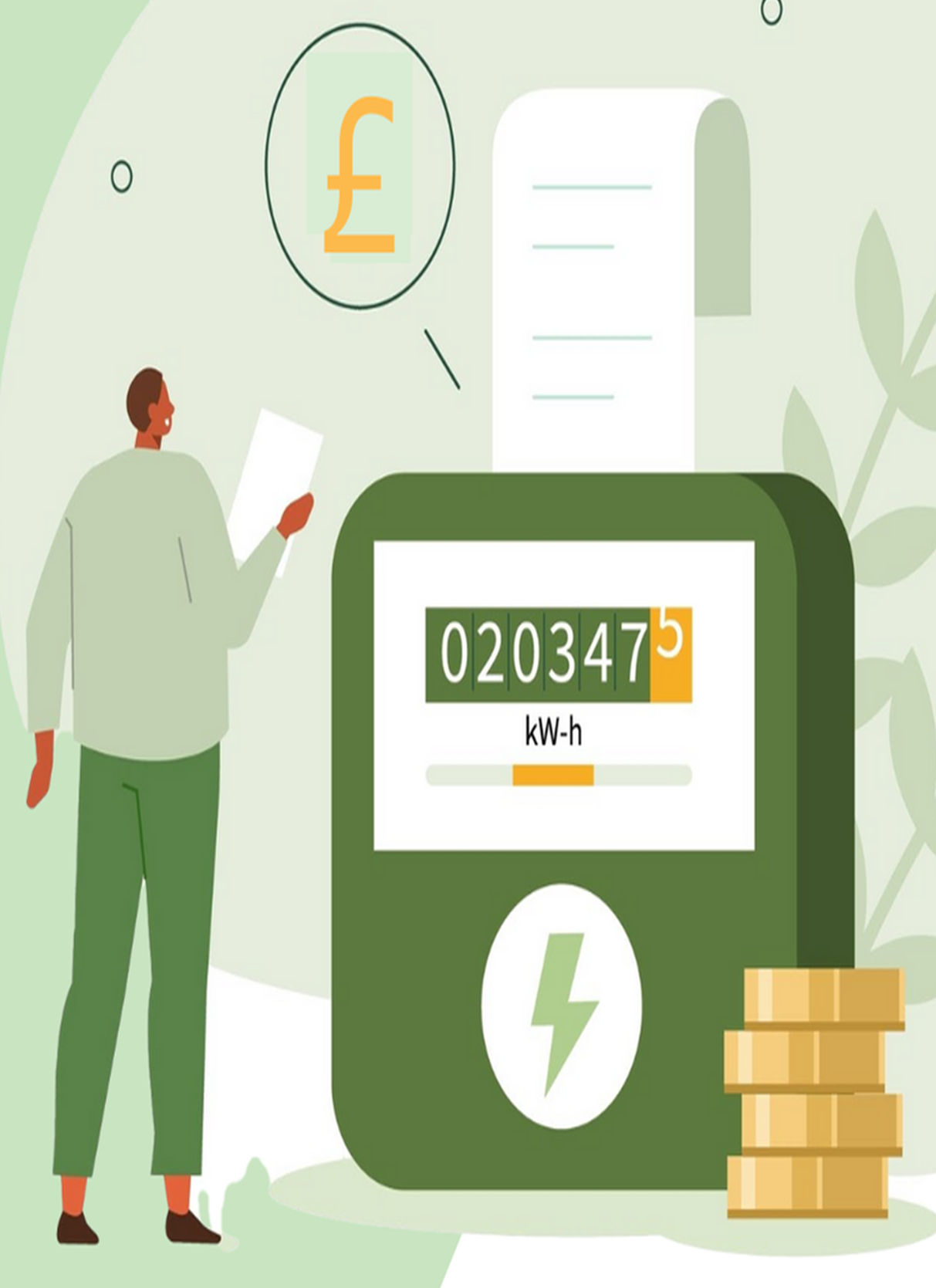
Keypad electric meter
Your keypad meter could help you understand your electricity usage:
- Press # to see the amount of credit left
- Press 1 to see the credit time left in days
- Press 2 for the cost of the previous day’s, week’s and month’s use
- Press 3 to see the unit rates and number of units left
- Press 6 for the electricity being used presently in kilowatts – this will reduce when you switch appliances off
- Press 8 to see the highest consumption in any half-hour in the last 24 hours and when it occurred
Kilo what?
So what is a kilowatt? The power rating for electrical appliances is measured in watts (W) or kilowatts (kW).
A kilowatt is 1000 watts.
If a 1 kW appliance (like this fan heater) runs for 1 hour it will use 1 kWh (kilowatt hour) of electricity.
Units of electricity are measured in kWh and counted through our electricity meters.
The price for a unit of electricity is shown in pence per kWh and that’s what energy suppliers use to bill us.
On a prepayment meter (PPM/top-up meter) your credit will run down with each kWh used.
Energy unit price
You can find your current electricity unit price on your energy bill or by contacting your supplier. By law they must provide you with this information.
If you have a prepayment meter (PPM) you won’t get an energy bill often, so contact your supplier or use the Consumer Council energy comparison for up-to-date information: www.consumercouncil.org.uk/consumers/help-consumers/electricity-oil-and-gas/electricity-price-comparison-tool.
Work out the running costs of your appliances
By understanding the power rating, the electricity unit rate of your supplier and using the following simple formula it is possible to work out the running costs of your appliances:
Appliance running cost (p/hr) = Power rating (W) x Electricity unit rate (p/kWh) ÷ 1000
If you want to work out the cost per minute, just divide the result by 60!
Of course, some items will only be on for a few minutes and some several hours so the actual costs will vary. Due to that price cap changing regularly and differences between makes and models, the age of appliances and because things like heaters, cookers, washing machines and tumble dryers use different amounts of energy while they run, it can be tricky to give exact costs. A higher rating doesn’t always mean higher cost. E.g. your kettle might have a high rating but you likely won’t turn it on for an hour! Choosing energy efficient electrical items can help. A is the most efficient. Look out for ratings labels.
For some appliances the electricity consumption varies during operation due to having a thermostat. In this case the power rating is the maximum power consumed by the appliance. National Energy Action has carried out testing of a variety of appliances to determine their actual consumption in use.*
The table shows average costs of using appliances. Use it to see where you could make savings.
| Appliance | Rating (watts) | Cost per hour |
| Electric shower | 7,000 – 10,500 | £2.16 to £3.25 |
| Immersion heater (single rate tariff) | 3,000 | 93p |
| Supplementary heating (e.g. fan heater) | 1,000 – 3,000 | 31p to 93p |
| Kettle | 2,500 – 3,000 | 77p to 93p |
| Grill/oven | 2,000 – 2,400 | 31p to 62p |
| Airfryer | 1,000 – 2,000 | 31p to 624p |
| Microwave | 700 – 1,400 | 22p to 43p |
| Slow cooker | 150 – 300 | 5p to 9p |
| Fridge-freezer | 100 – 300 | 3p to 9p |
| Games console | 100 – 200 | 3p to 6p |
| LCD TV | 25 – 175 | 1p to 5p |
| LED GLS Bulb | 6 – 10 | Less than 1/2p |
| Broadband router | 5 – 15 | Less than 1/2p |
| Extractor fan | 5 – 10 | Less than 1/4p |
| Phone/tablet (charging) | 2 – 15 | Less than 1/2p |
Common medical device running costs over a month
The table below from Marie Curie’s report, One charge too many, shows the potential monthly cost of using at-home medical equipment. It is based on average usage assumptions and reflects typical NI energy prices in early 2025.
| Medical device | Consumption per day (kWh) | Monthly energy cost |
| Ventilator: run for 24 hours a day for most patients. | 3.6 | £33.38 |
| Oxygen concentrator: long-term oxygen therapy of 15 days or more improves the prognosis for people with COPD. | 6.6 | £61.20 |
| Haemodialysis machine: performed six or seven days a week for about two hours each time. | 2.76 | £25.59 |
| Nebuliser: dose is given as a single administration, or as two 1mg doses separated by 30 minutes. Repeated every 12 hours for a maximum of 36 hours or until clinical improvement. | 1 | £9.27 |