
The Warm Homes Plan, published in January 2026, sets a clear ambition and a welcome target of upgrading 5 million homes, including lifting 1 million homes out of fuel poverty.
Additional grant funding for low-income households to decarbonise their homes will reach owner–occupiers and social renters. New standards for landlords to meet will take over half a million out of fuel poverty. And a new ‘Warm Homes Agency’ will support delivery through an online service and national phone line.
This has the potential to have a positive impact, and National Energy Action will seek to:
- Ensure safe passage of regulation setting new standards for landlords
- Work with UK government to ensure that grant funding comes with advice and handholding
- Advocate for the new Agency to prioritise reaching, and helping, those most vulnerable to the impacts of fuel poverty.
However, in its current form, there is a real risk that it does not deliver warmth for low–income and vulnerable households. Many low-income owner–occupiers who live in some of the least efficient homes still have few routes to practical upgrades.
What must change?
New standards for landlords are important, yet routes to consistent enforcement are not defined, risking a lack of compliance. Electricity prices remain high relative to household budgets, which could leave some heat pump users facing high running costs. Access is often digital first, grant availability varies by area, and the pathway from health and care into funded works is not yet clear. Together these features risk leaving behind fuel poor households. National Energy Action’s work across communities shows that without clear access routes, the lowest income households are consistently the first to fall through the gaps.
Ringfencing a small share of programme budgets for independent advice, handholding and aftercare, delivered with trusted local partners, would ensure the most vulnerable households can confidently access support. National Energy Action has developed community retrofit hubs that offer handholding energy advice to the most vulnerable, and our evidence shows this approach increases take-up, ensures correct use of new technology and makes savings last, especially for those who would otherwise face barriers to inclusion.
Create a clear health pathway. National Energy Action’s Warm Homes, Health Futures programme has demonstrated that health–connected energy referrals are one of the most effective ways to reach people whose health is harmed by cold and damp homes. Embedding this learning nationally would ensure these households are identified earlier and are more likely to receive support.
Guarantee a fair route for owner–occupiers in every area so that no household is excluded simply because of where they live or how digitally–confident they are. Consolidating area-based grants is necessary but must be done alongside a national self-referral backstop. This would allow individuals to ‘put their hand up’ and crucially give more tools to advice organisations like National Energy Action to triage to a national scheme with greater clarity.
Deliberately prioritise enforcing new regulations so that the people living in the coldest, dampest homes see real protection, not just new rules on paper. Regulations will only deliver warmer homes if compliance is monitored and enforced. Many of the most vulnerable tenants rent from landlords least likely to act without clear oversight. Local authorities need the resources and tools to uphold standards, supported by national guidance and a clear information campaign for tenants and landlords.
With these adjustments, the plan will be more likely to provide warmth for the people who need it most. Based on our evidence, success will be visible in: a higher share of upgrades in the lowest income deciles and in the least efficient homes; better health outcomes for those referred through the health pathway; and stronger tenant protections in the private rented sector.
Contact: matt.copeland@nea.org.uk
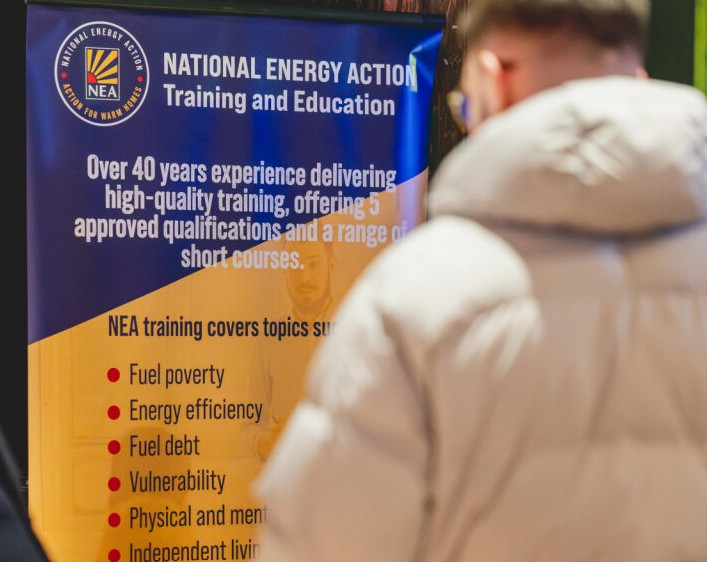
Our Training and the Warm Homes Plan
National Energy Action’s dedicated Training team delivers a comprehensive range of courses designed to support households experiencing fuel poverty and to promote energy efficiency, decarbonisation, and more.
Our training will equip you with the skills to identify vulnerable households and offer practical, informed advice. You will also learn how to signpost people to additional support services. For those seeking technical knowledge, we offer specialist courses covering smart meters, renewable energy technologies, and other innovations that help households participate in the green transition.
Our full suite of courses is designed to help organisations play their part in delivering the Warm Homes Plan.
We continuously update our training with the latest guidance and insights, ensuring your organisation stays informed and responsive to emerging issues. Our course content is shaped by NEA’s own research and policy expertise, as well as the real-world experiences of our frontline advice workers.